

Ever since I started working heavily with AI, my compute needs exploded—not just in the cloud, but on my desk.
One screen wasn’t enough. Two wasn’t enough. Before I knew it, I had dug out an old laptop, and my desk turned into mission control: main computer in the center, one laptop on the left, another on the right.
The idea was parallel processing. The reality was pure ADHD chaos.
Every time I looked away from one screen to glance at another, my working memory completely wiped. What was I doing here? Why is this terminal open? What was the train of thought?
Productivity gurus will tell you to keep a running task list to manage context switching. But for an ADHD brain, a digital list is just another window to minimize. And once a window is minimized, it ceases to exist in the observable universe.
This is why people with ADHD have messy desks. It’s not that we’re slobs; it’s an external RAM issue. If an object isn’t physically within line of sight, object permanence simply clocks out.
So I ditched the apps and ordered a bag of wooden carving blocks. The kind people buy on Amazon to whittle little bears out of.
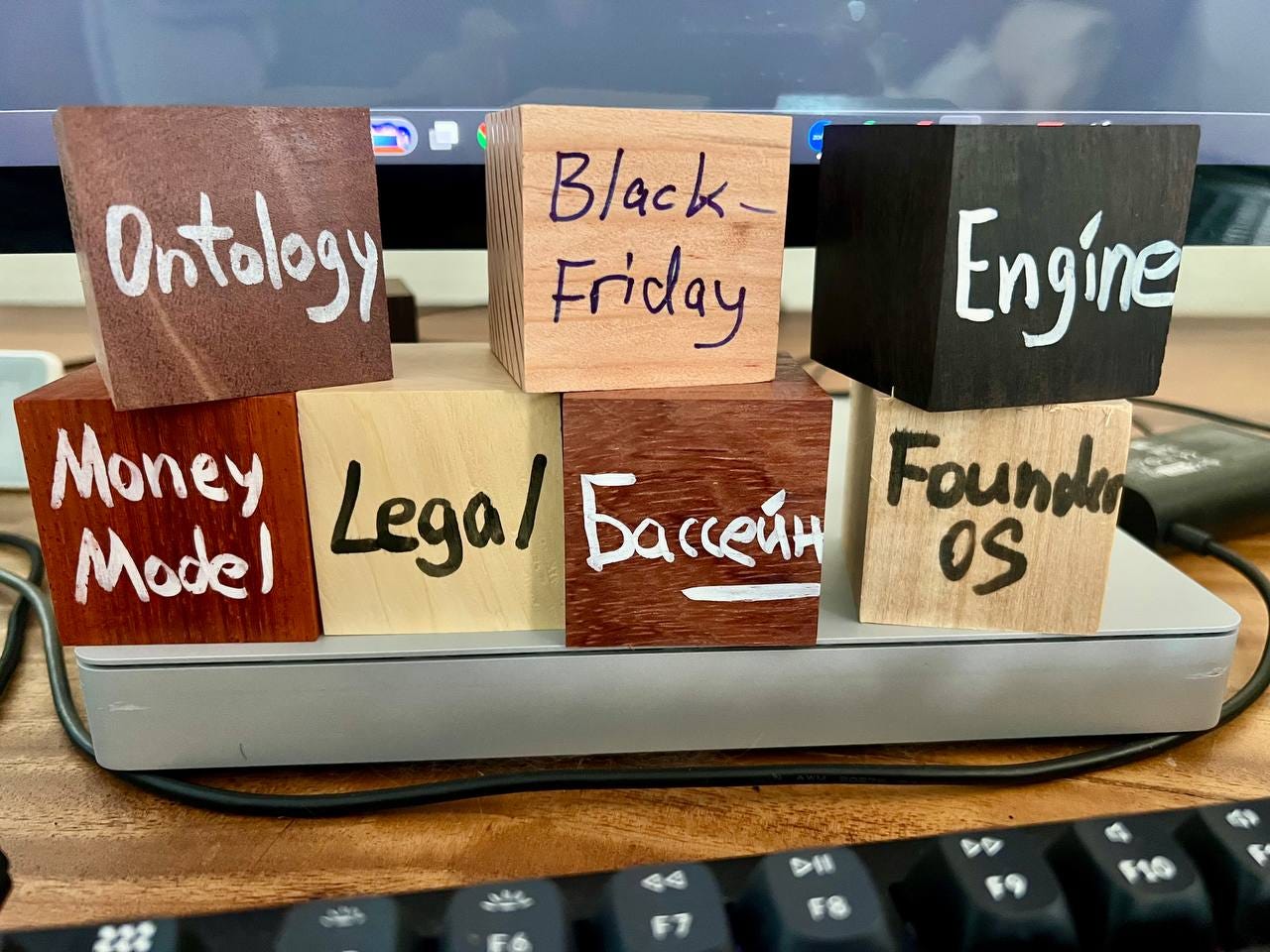
I took a marker and wrote my active streams on them: Ontology, Engine, Founder OS, Money Model, Legal, Black-Friday—and, underlined for dear life, Бассейн (Pool), don’t ask what is it, it’s not a real pool, it’s a secret science project.
Now, these blocks physically move across my desk.
If the left laptop is currently working on architecture, the Ontology and Engine blocks sit right next to its trackpad. If the desktop is crunching finances and sanity, Money Model and Бассейн live there.
It sounds ridiculous, but it works insanely well.
Your eyes drift over actual, tactile wood. You don’t have to reopen an app or decode a dashboard. Your brain catches the shape and the handwriting in your peripheral vision, and the entire context reloads instantly without the cognitive tax.
I haven’t bothered to look up any neuroscience papers to justify this. All I know is that my three-machine AI setup is currently being held together by seven pieces of scrap wood—and my brain has never felt more organized.

P.S. Okay, fine. I couldn’t help myself and went down the rabbit hole to see what science actually thinks about this.
Turns out, there are official names for it: cognitive offloading and epistemic action—which basically means manipulating physical objects so your prefrontal cortex doesn’t melt trying to hold everything in RAM. Plus, flat screens are where spatial memory goes to die. Pixels have no real-world coordinates, but a block of walnut on the left corner of a desk immediately taps into your hippocampus and 3D navigation.
(I once tried going full true-crime detective with a corkboard, pins, and red yarn connecting ideas like a maniac in a thriller. It lasted about two days. Startup reality shifts every forty minutes, and nobody with ADHD has the patience to re-string yarn five times an afternoon. Wood blocks are zero-maintenance.)
Curious—how do you use physical space or spatial thinking in your own workflow? Or are you running purely on 87 open tabs and prayer?