
Stop Fixing Your ADHD. Fix What You Feed It.
Every article about ADHD is trying to fix the person. The evidence says the problem was the room. I stopped trying to fix myself years ago, and that's when the work got good.

Like a lot of founders, I got the full neurodivergent starter pack. ADHD, perfectionism, an anxiety disorder, the kit apparently issued at birth to inventors, entrepreneurs and other people for whom reality is never quite enough.
I’m forty. I have cured none of it. What I’ve learned instead is how to live with it, which is a much harder thing to put on a slide.
The hard part was never attention. It’s executive dysfunction. I can run a company, hold a product strategy in my head, take apart an ugly technical problem, write twenty pages in a day.
And opening WhatsApp can be genuinely frightening.
Booking a dentist appointment is a three-act drama with its own emotional arc. My morning is the only time I can open my email. Thank god I didn’t start a b2b SaaS with a manual sales cycle.
I’m also the most productive I have ever been in my life. Not “for someone with ADHD.” The most productive I have ever been, and my team will say the same. When I sat down to work out why, the answer turned out to be really interesting. It was never about fixing the machine. It was about changing the inputs.
This is for anyone who has this brain and is tired of losing to it, and for the managers who don’t realise what they’re sitting on.
The deal
Here’s the trade, stated flat, because everything below is just the reasoning behind it.
Far more output, and nobody gets to choose the task or the date. Those two things arrive together.
They aren’t a preference and they aren’t a request. It’s how the machine works, and the terms don’t move because I’d like them to or because you would.
Take the trade and you get the problems nobody else will crack. The thing that’s been rotting on the roadmap for two years, finished on a Sunday. The strategic contradiction everyone has been carefully walking around for a year and a half.
Refuse it, insist on this ticket by Thursday, and you get a mediocre unreliable employee who hates themselves. You’ll conclude the employee was the problem. It was the system design.
Almost every company refuses. Not out of cruelty, out of a decision they made so long ago they’ve forgotten it was a decision.
And it is a trade rather than a petition, which means either side is free to walk. Nobody is getting anything out of me. A company that wants the deadline more than the output is welcome to go and find someone who sells deadlines, and I’m welcome to decline the job.
Which matters most if you’re the one with this brain rather than the one managing it, so let me put it as plainly as I can.
If you’re inside a company that runs on tight control and hard dates, you are not going to do well there. Not “it will be difficult.” You won’t. So all the caution you’re currently exercising — not mentioning it, agreeing to the Thursday date with a confidence you don’t have, quietly hoping this quarter goes differently — is buying you nothing at all. It’s protecting an outcome that was never on the table.
Which makes the honest conversation with your manager close to free. The worst case is you find out early that the fit is wrong, and finding that out early isn’t a cost. Have it at the start rather than in the post-mortem of the thing you missed, and you at least create the possibility that the two of you end up pleased with each other. And if you don’t have a manager, because you’re freelance or founding or between things, the same trade is available with yourself. That’s the version I run most days.
That possibility is real, by the way, because I run the other side of it. I have people who get more done in four days than they used to in five, and I’m entirely fine with it, because I can see the output. We have enough neurodivergent people that at some point we stopped designing for the other case. We don’t count hours. We rarely set deadlines. Paid time off isn’t capped. We plan around what’s actually burning for someone this week rather than what a document said in January.
It works. Not “it works, with tradeoffs, and here’s our learning journey.” It works.
The price of attention
Everyone who’s been near this knows the wall. The thing that should take forty minutes, that you are fully capable of doing, that you cannot start.
Let’s put down the word “dysfunction” for a minute. Not because it’s unkind. It’s a bad model: it says the thing is broken, which says fix it, which is how you spend a decade and a great deal of money trying to become somebody else.
Try assuming the wall is doing a job. Then the question stops being how do I force myself and becomes what is this telling me?
I can push through almost anything on raw willpower. What varies wildly is the cost. Some tasks run a little discipline. Others are black holes that take every unit of deliberate attention I own and hand back nothing, and I mean the expensive kind of attention, the kind that doesn’t happen by itself. Kahneman’s System 2, if you want a label.
I personally feel like I will literally die if I have to do one of those. It feels like a black hole taking the life force out of me. I know how that sounds.
So the wall isn’t a warning light saying empty. It’s a quote. My brain has priced the task against every other thing that attention could be doing and declined at that price.
Which is irritating, and also the single most useful thing I ever worked out about myself. You can’t argue with a price using willpower. Nobody stands in a shop shouting at a label. You argue with a price by changing what’s on offer.
Then there’s the other end of the same system. Hyperfocus, where a project stops consuming attention and starts generating it. You don’t fight to concentrate, you fight to stop. You forget that time is a thing. You work for nine hours, solve something that looked impossible on Tuesday, and produce what would be a decent week for a competent adult.
Same brain. Same person. Still hasn’t answered the message from four hours ago.
This normally gets filed as a contradiction. Dysfunction is the disability, hyperfocus is another symptom of the disability, both need managing. I think that’s exactly backwards. These aren’t separate symptoms. They’re two ends of one system, the system works fine, and there’s nothing unusual about it.
It just has an enormous range. And systems like that exist all over the place and work beautifully, which I’ll show you in a minute.
You don’t live in Mediocristan
Taleb has a pair of imaginary countries I think about constantly.
Mediocristan is where no single observation moves the total. Take the height of a thousand people, add the tallest human alive, the average barely twitches. Variation exists and stays contained. Physics won’t permit a person forty times taller than the mean.
Extremistan is where one observation eats everything. Take the wealth of a thousand ordinary people and add one billionaire. The average is now a number describing nobody in the room, including him. The outlier isn’t noise around the system. The outlier is the system.
(A disclaimer, because the words are unfortunate: Mediocristan isn’t a comment on anybody’s abilities. It’s Taleb’s term for a shape of distribution, and I’m borrowing it for that and nothing else.)
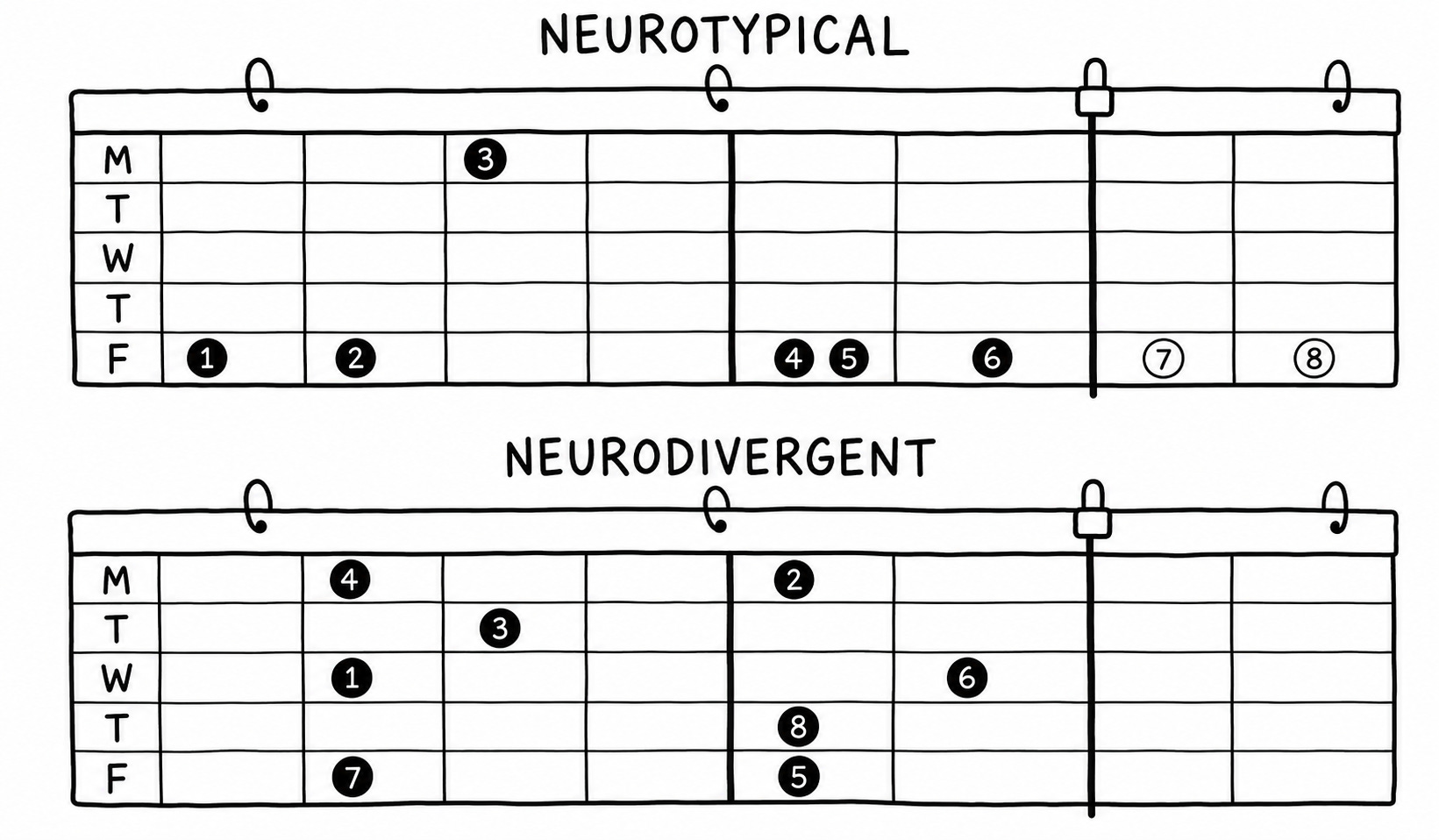
A neurotypical person has preferences. Output fluctuates, there are good days and bad ones, the boring task costs more than the interesting one. But the range stays fairly stable. Most days produce something, most tasks get done at a tolerable price, and if you watch someone for three days you have a fair idea of their month. That’s Mediocristan, and it’s why sprints work, why tickets work, why the whole apparatus of modern work functions at all.
My range is not like that. I can produce nothing visible on the assigned project for a week and then generate something extraordinary somewhere else in an afternoon. A handful of extreme periods creates most of my annual value.
Watch me for three days and I look chaotic, unreliable, possibly lazy. Watch me for a year and I’ve produced more than almost anyone around me, with the exception of the other neurodivergent people on my team.
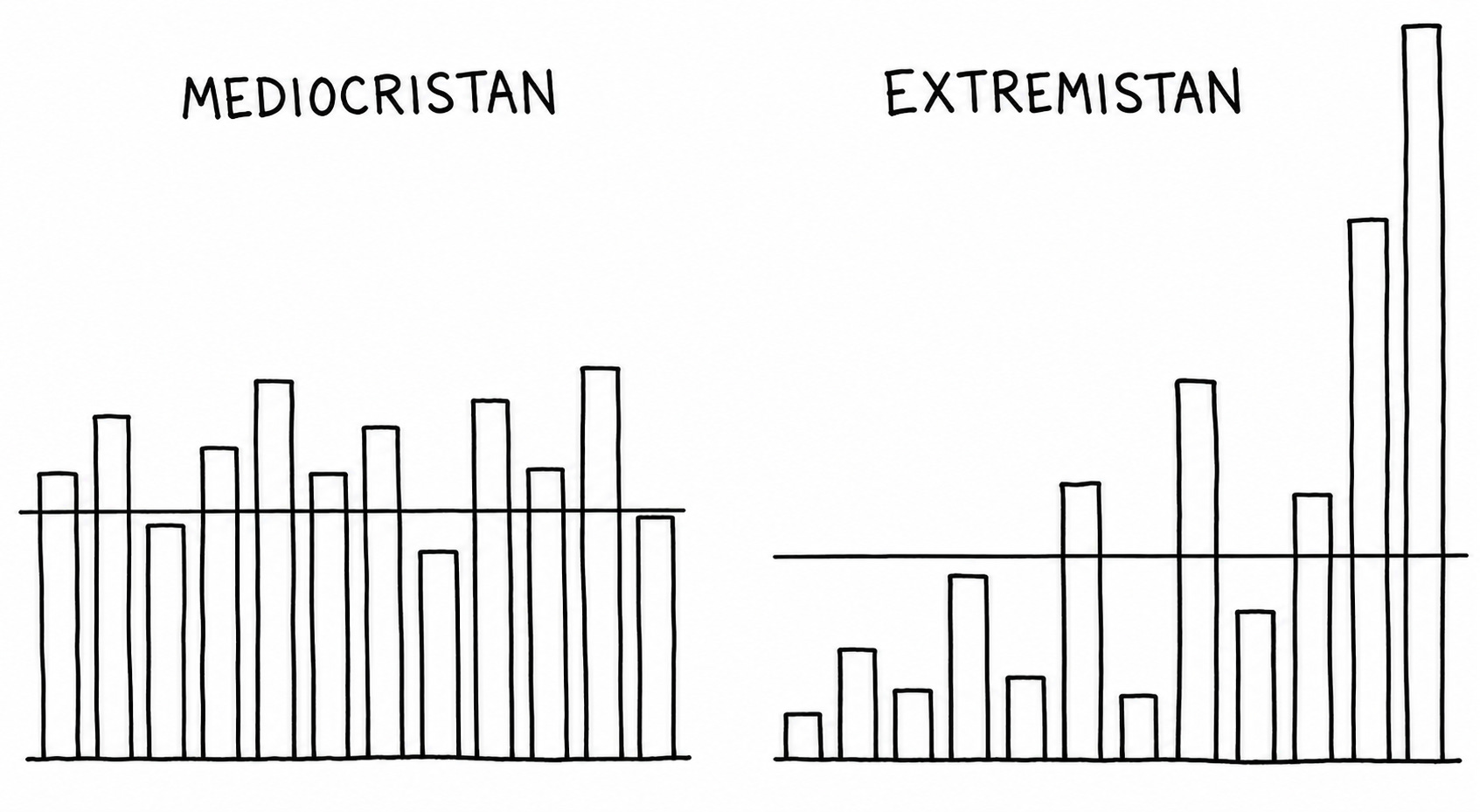
The mistake is treating an Extremistan system as a defective Mediocristan one. It isn’t the same machine performing badly, it’s a different machine on different rules. And when an organisation sets out to smooth the spikes, it usually succeeds, which is the problem, because the spikes were the reason they hired the person.
Which brings me to the part that should make a few of you uncomfortable.
Venture capitalists are the only profession on earth professionally trained to think in Extremistan. Power law. Outliers. One in twenty returns the fund. You have organised your entire economic existence around the proposition that a fat tail beats a tidy average.
Then you walk into a board meeting and revert to Mediocristan the instant somebody opens a headcount spreadsheet.
Genius on Tuesday, idiot on Thursday
Modern work is a conveyor belt. A task arrives, a person receives it, a date gets attached, the person finishes and takes the next one. The design assumes tasks are roughly interchangeable, that preference is a minor variable rather than a hard constraint, and that effort converts almost any input into output.
That’s a good design. I want to be clear about that, because I’m not arguing the conveyor is stupid. It’s excellent for making cans of soup, and predictability is what you can actually sell upward, to a board, to a market, to an acquirer. The conveyor manufactures predictability beautifully.
It’s a catastrophic fit for a wide-range mind.
In that system I look brilliant when the belt happens to deliver something matching my current configuration, and like an incompetent fraud when it doesn’t.
Genius on Tuesday. Idiot on Thursday.
And everyone concludes the person is inconsistent, which, fine. But notice the company is also being inconsistent. It’s feeding random inputs into a highly specialised machine and acting surprised when the engine smokes.
So let’s reverse the question. Instead of asking how someone like me adapts to a world built for the narrow range: how would work be designed if this were treated as a normal mind?
We don’t have to imagine it. Somebody built it already, by accident, and it’s worth billions.
It’s the room, not the kid
It’s professional sport.
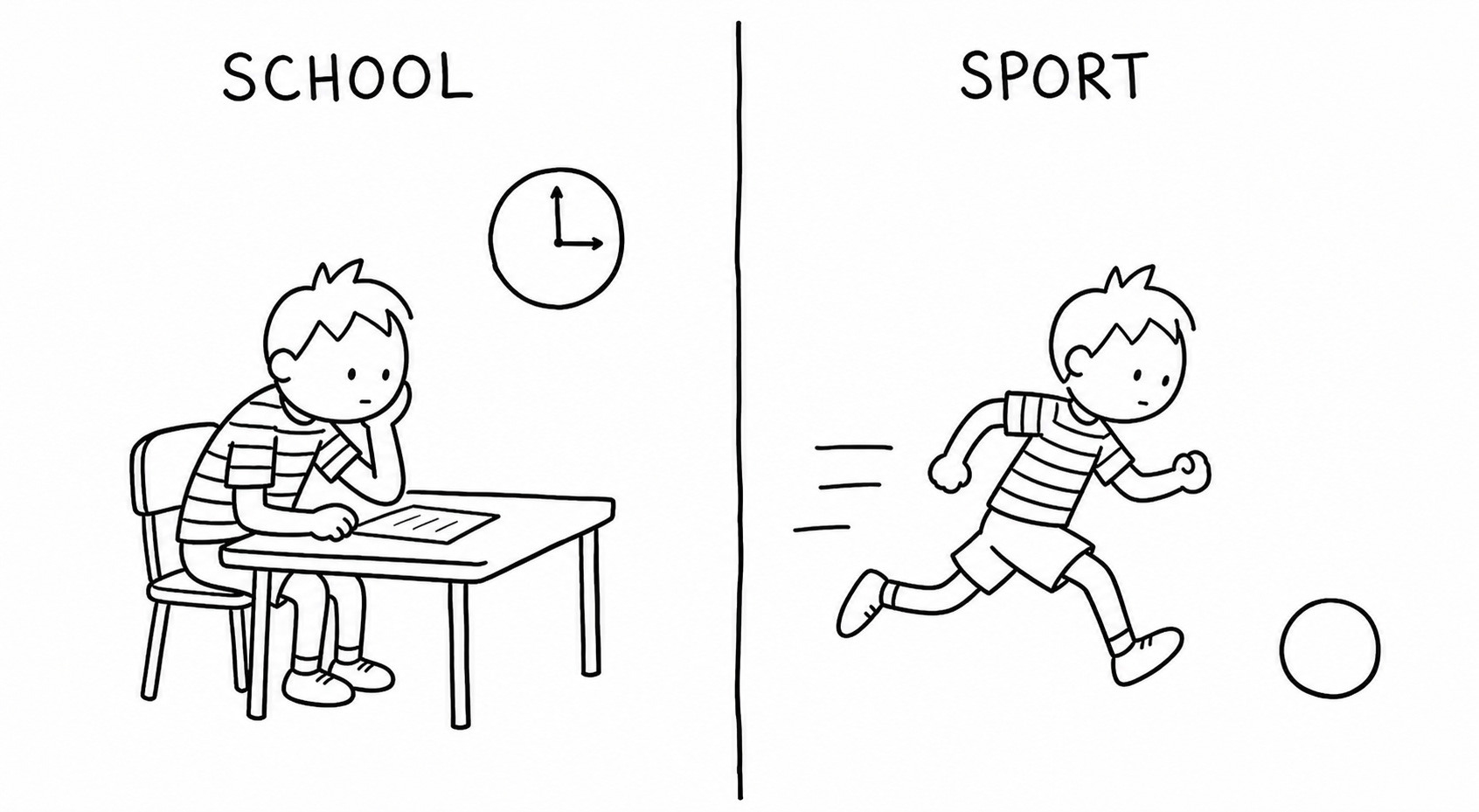
In 2021 a Swedish group at Karlstad University did something almost nobody thinks to do. They took high-level youth athletes and had a trained psychotherapist score them on a standard adult ADHD symptom scale. Twice. Once for how they function at school, once for how they function in their sport.
Same kids. Same instrument. Same week.
High scores at school. Low scores in sport.
Sit with that, because it’s the whole argument compressed into one experiment. The symptoms did not travel with the child. They appeared in one room and receded in the other. Whatever the school assessment measured, it wasn’t a property of the kid. It was a property of the kid plus the room.
And this isn’t “he tries harder at the fun thing.” These are clinically shaped scores on a validated instrument, moving because somebody changed the context.
Look at what sport supplies and the reason stops being mysterious. Immediate feedback. A visible score. Real stakes. Intense, varied stimulation. Consequences that land in seconds instead of at the end of the quarter. Sport is structurally a place where an attention system that discounts the future steeply and runs on interest is finally at home, and nobody redesigned it to be that way out of kindness. It was already like that, because that’s what makes sport worth watching.
The prevalence numbers point the same way, modestly. A 2019 review in the British Journal of Sports Medicine puts ADHD at roughly 7–8% among student and elite athletes against something like 3–7% in the general population. Overlapping ranges, and it’s a narrative review rather than a meta-analysis, so don’t let anybody tell you it’s three times the base rate. Somewhat over-represented is the honest reading.
The visible end is less ambiguous. Michael Phelps, Simone Biles and Noah Lyles have all talked openly about ADHD. Alysa Liu, who took the 2026 Olympic figure skating gold, was diagnosed in high school and puts it about as plainly as it can be put: she loves situations she isn’t expecting.
Notice what did not happen to any of them. Nobody tried to cure them into steadier, more predictable athletes. They were just in the right room.
Now the part I have to say honestly, because it makes the point stronger rather than weaker.
Sport is not enlightened. A 2023 scoping review of neurodiversity in elite sport turned up 23 studies, and most were about ADHD as a risk factor for concussion, or about managing medication so athletes stay compliant with anti-doping rules. A genuinely supportive environment still gets described in that literature as future work. The lead author of the 2019 review says plainly that elite athletes often can’t get proper care because of stigma. Nobody in a locker room sat down and decided to build a strengths-based model of human variation.
That’s exactly why it’s useful evidence.
Sport didn’t get kind. It got shaped right, and the trait stopped presenting as a deficit anyway, and an entire industry monetised the result without ever needing a theory about it. Which is a far more actionable conclusion than “find a nicer employer.” The same trait, in a different room, produces a measurably different person.
Your job is to pick the room.
The answer isn’t one project
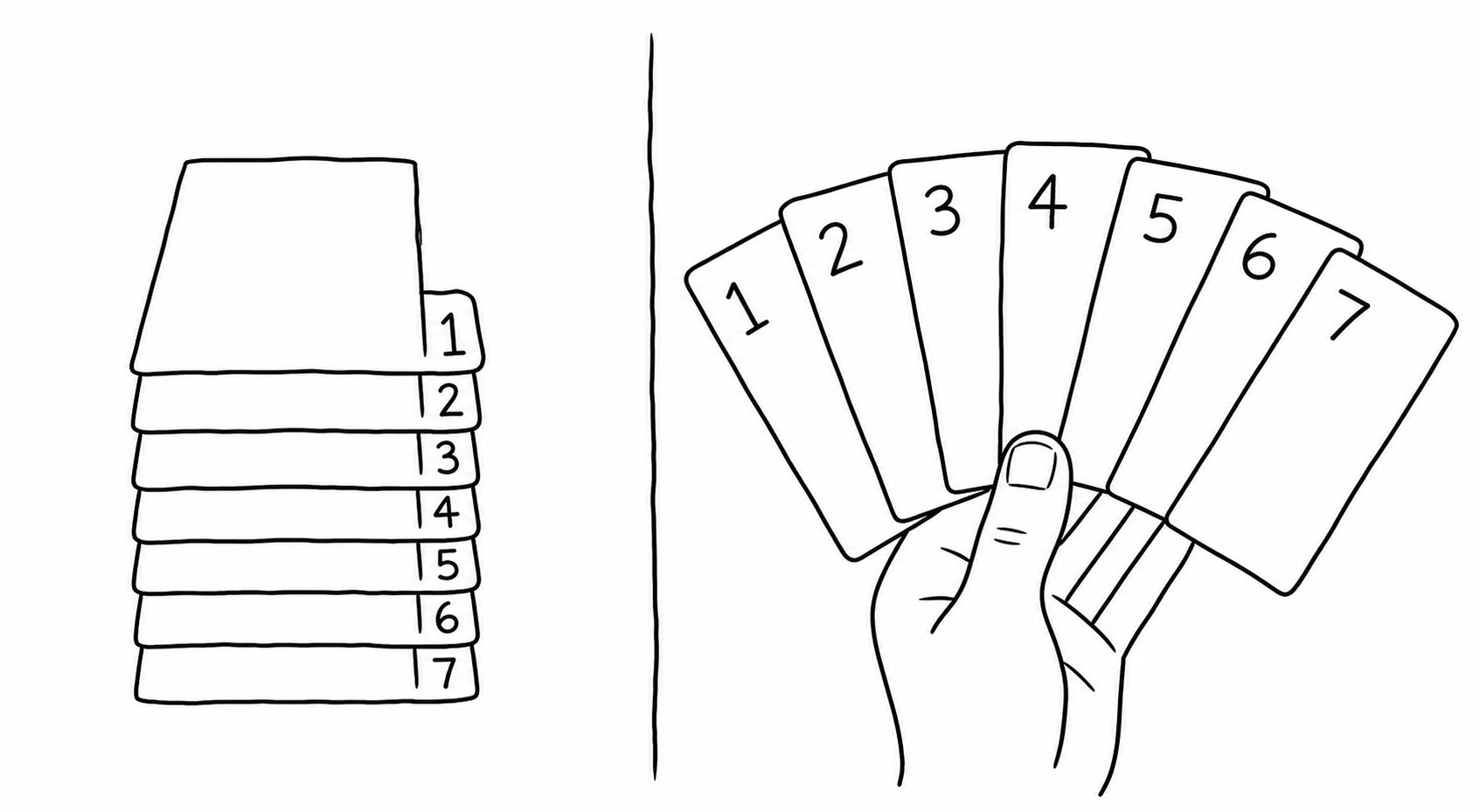
A hyperfocus-driven person shouldn’t have one active project. They should have seven. Or eleven, or seventeen. The number is irrelevant, the diversity is the whole thing.
And it isn’t a queue, which is a word I used for years before noticing it was wrong. A queue has an order and you work through it, and the order is exactly the part that doesn’t function. What you want is a fan. Everything laid out at once, all of it live, none of it next.
Which is a shape you already know if you invest for a living. Nobody works through a portfolio in sequence. You hold twenty positions simultaneously precisely because you cannot tell in advance which one pays, and the whole discipline consists of having enough good ones open at the same time. Run your attention the same way and the logic is identical, including the part where most of them go nowhere.
I wake up, look at what’s laid out, and notice which one is pulling. This is rarely subtle. Hyperfocus tasks have gravity, you can feel the project waiting for you.
Standard management calls choosing work this way unfocused, and adults are supposed to do what they planned rather than what they happen to find interesting on a Tuesday. But that objection assumes the goal is maximum predictability per task. Give me several important problems and I spend far more hours in the state where work costs nothing and produces disproportionately. Any individual project gets harder to forecast. Total production goes up, and not by a little.
There’s the trade again. Less predictability per task, much more output per system.
Most people would commit crimes for the ability to drop into deep flow by picking the right project. People with ADHD frequently have exactly that ability and spend their lives apologising for it.
Hyperfocus amplifies whatever you feed it
There’s a fair objection here and I want to give it properly, because the people making it usually have this and are tired of being told it’s a gift.
Hyperfocus is a mechanism, not a moral compass. It lands on a Wikipedia rabbit hole about ball bearings as happily as on your architecture problem. Six hours reorganising a database nobody needs. Perfecting the typography of an internal document four people will read. Anyone who’s done that does not experience it as a superpower.
But the uselessness of the output doesn’t prove the mechanism is useless. It proves you fed it garbage.
Hyperfocus amplifies whatever it lands on. If your environment offers an endless supply of cheap stimulation and no accessible, compelling, meaningful work, it will faithfully and powerfully amplify Wikipedia at three in the morning. The mechanism performed perfectly on what it was given. Nobody looks at a model trained on junk and concludes the model is broken, they look at the dataset. Then they look at you and blame you.
So the real work happens before the work. Keep an inventory of diverse, valuable, accessible problems. Not a backlog of administrative debris, not a graveyard of obligations copy-pasted out of quarterly planning. An actual inventory:
a gnarly product architecture
a research question
a half-written essay
an unusual negotiation
a strategic contradiction nobody has named yet
a customer problem no one understands
a high-risk experiment with an enormous upside
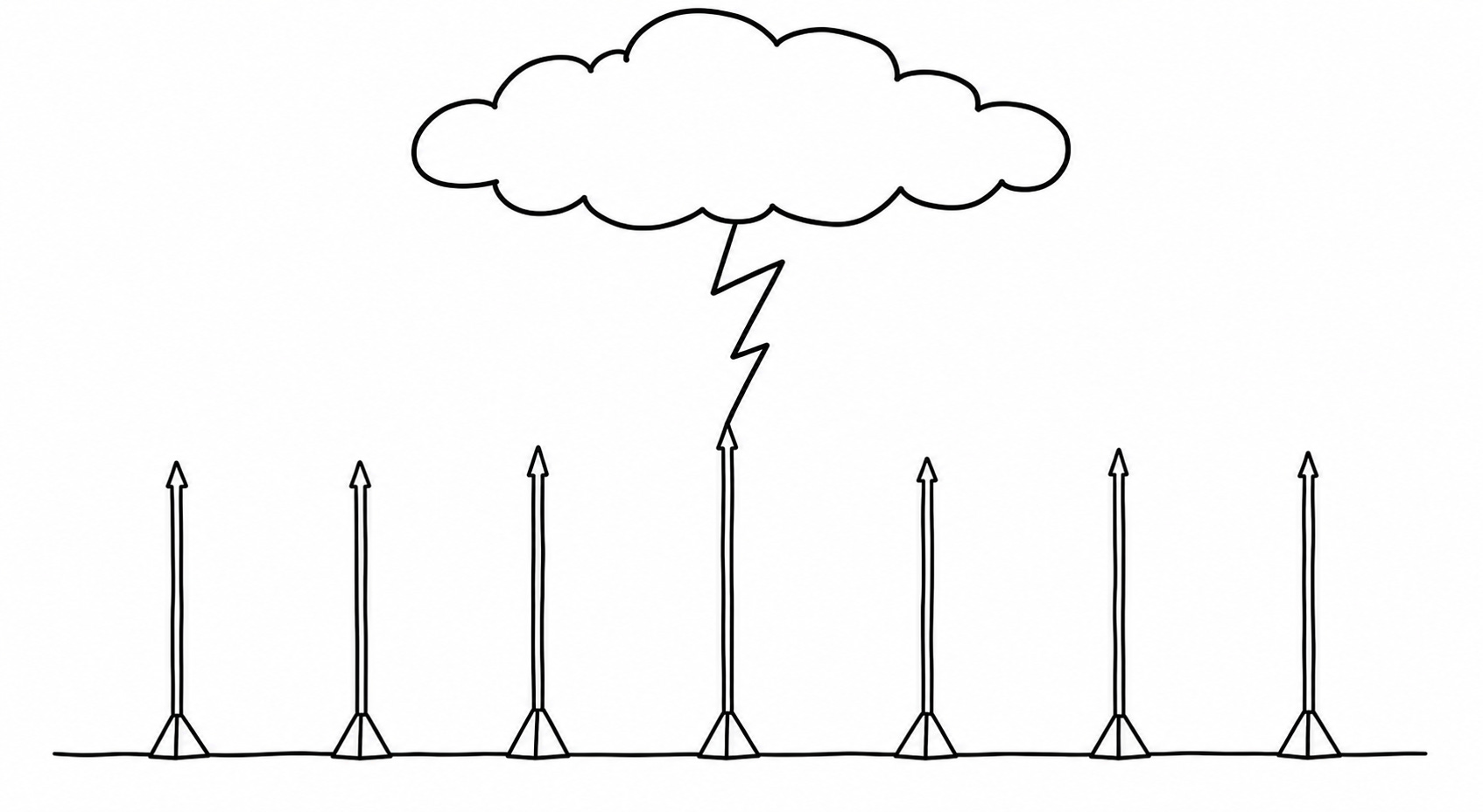
You can’t schedule the lightning. But you can decide where to put the rods.
What it looks like when it works
There was a thing on our list for years. Useful, structurally important, complex enough that it never quite cleared the priority bar. You know the type. Too big to squeeze in, never urgent enough to schedule, so it sits there getting older and quietly making everybody feel slightly bad.
Then one Friday my hyperfocus walked into it. No plan, no decision, just this rising oh, hang on, this can actually be done, you do it like this and then like this.
I did it over the weekend. A properly valuable, entirely non-urgent piece of our strategy, finished on Monday after sitting unfinished for years.
Now, before anybody draws the wrong conclusion about the weekend.
I subordinate my calendar to my hyperfocus rather than the other way round, which means there are very quiet days in the middle of my week. On purpose. Days kept clear so there’s room to switch and room to rest, because you can’t run the expensive end of a factory without slack around it.
If anything in my life is predictable it’s the walks, the sport, and the hours with no hyperfocus in them at all. Those are the fixed points. Everything else is weather.
So when I work on a Saturday it’s not because I bought the fairy tale, the five hours of sleep and the pizza and the grinding until 4am and the whole tedious mythology. That’s bullshit, and I think it has quietly wrecked people who’d otherwise still be building things. You’re supposed to build a schedule that accounts for how you actually work, and to understand that this is a marathon.
I just refuse to run the marathon on somebody else’s calendar.
Goldratt: not every machine gets managed the same way
The Goal, Eliyahu Goldratt, 1984. A plant manager has three months before his factory gets shut down, and what he works out seems obvious the second you see it and remains almost impossible for organisations to accept.
Not every resource in a system should be managed the same way.
A machine that isn’t the constraint can sit idle without costing the factory anything. The bottleneck is different: every hour lost there is an hour lost by the whole system, permanently. And a complex expensive machine often needs substantial setup time to switch between kinds of work, so if you reconfigure it for every incoming order you destroy its useful capacity while feeling extremely responsive.
The answer isn’t to shout at the machine. You organise the system around it. Protect it from interruption. Keep a buffer of work in front of it so it never starves. Batch similar jobs while it’s already configured. Don’t burn its scarce capacity on things other resources could do.
People aren’t machines. The management principle transfers anyway.
Some people are reliable general-purpose processors. Hand them a well-defined sequence and they move through it steadily, and thank god for them, because they’re why anything ships at all. Others are rare, expensive, long-setup machines with extraordinary output in the right configuration. Managing both identically isn’t fairness, it’s laziness.
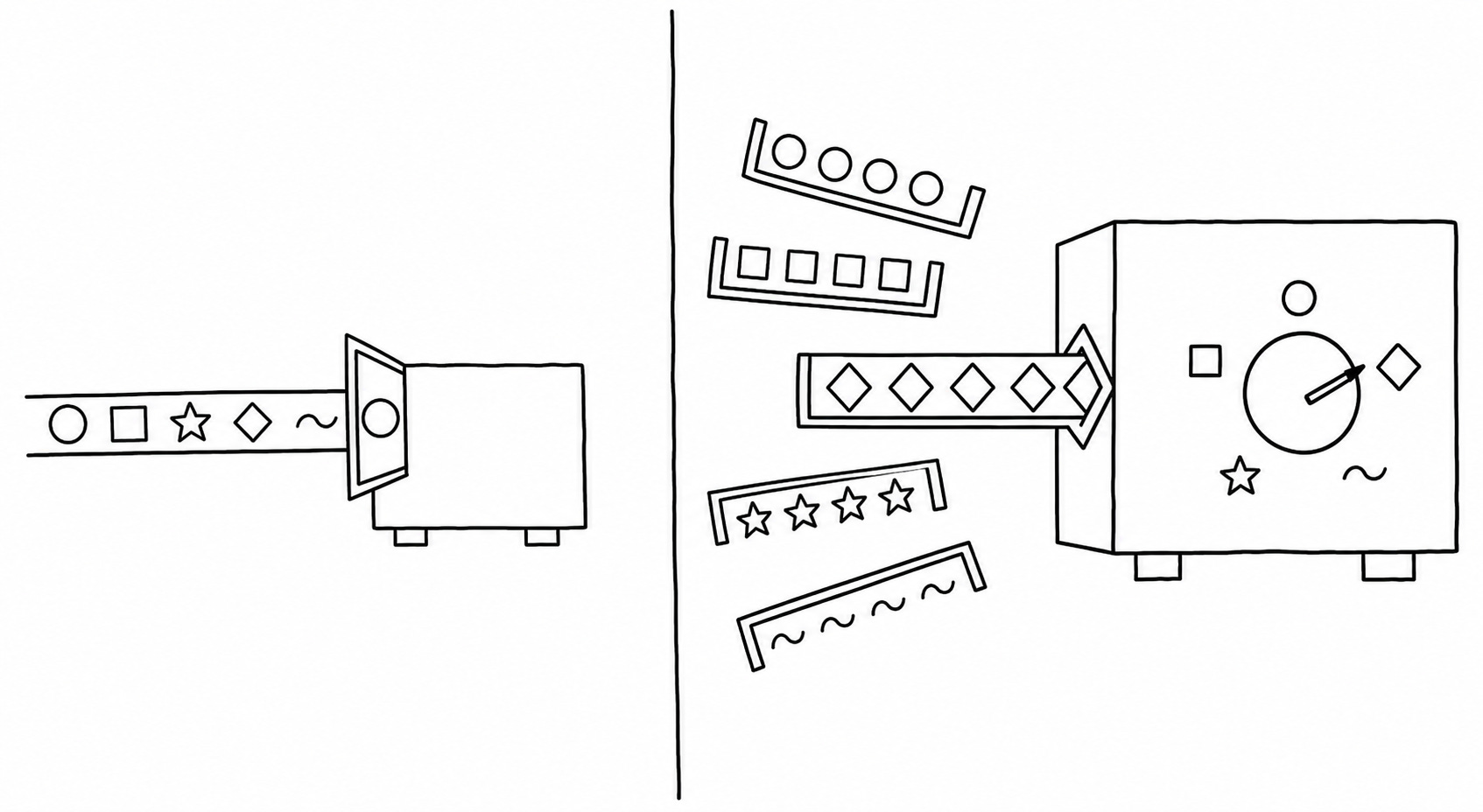
This turns a vague complaint about interruptions into something specific. When a hyperfocus-driven person has finally reached a productive configuration, pulling them out for a status update, a context switch, a Slack thread, a routine meeting or an expense report is exactly equivalent to stopping the bottleneck halfway through a valuable batch because another order came in.
It makes the local plan look tidy. It wrecks total throughput.
Why companies fight this even when it works
So if the deal produces more value, why does almost nobody take it?
Donella Meadows gives you most of the answer, and it isn’t malice. It’s delay.
Complex systems separate action from consequence in time. Something happens now, its real effects surface later, and humans are famously terrible at this. We respond to what’s visible, usually well before the system has finished telling us what actually happened.
In the short run a hyperfocus-driven worker looks alarming. They move between projects, some tasks sit longer than forecast, progress is lumpy, daily output is unpredictable, the board is untidy.
So a manager intervenes, and every single intervention is reasonable on its own terms. Cut the number of projects. Forbid switching. Tighten the dates. Add check-ins. Require visible daily progress. Finish the current thing before touching anything else.
The immediate result is genuinely reassuring. The person is sitting in front of the correct task, the board is clean, control has been restored.
The real result shows up a quarter later. Less time in deep work, fewer breakthroughs, the hard problems still unsolved. More cognitive budget going to self-coercion, which raises anxiety, which worsens avoidance. Eventually output falls, or the person burns out, or quietly leaves.
But the feedback arrived too late to be connected to its cause. So the organisation concludes the person needed more control.
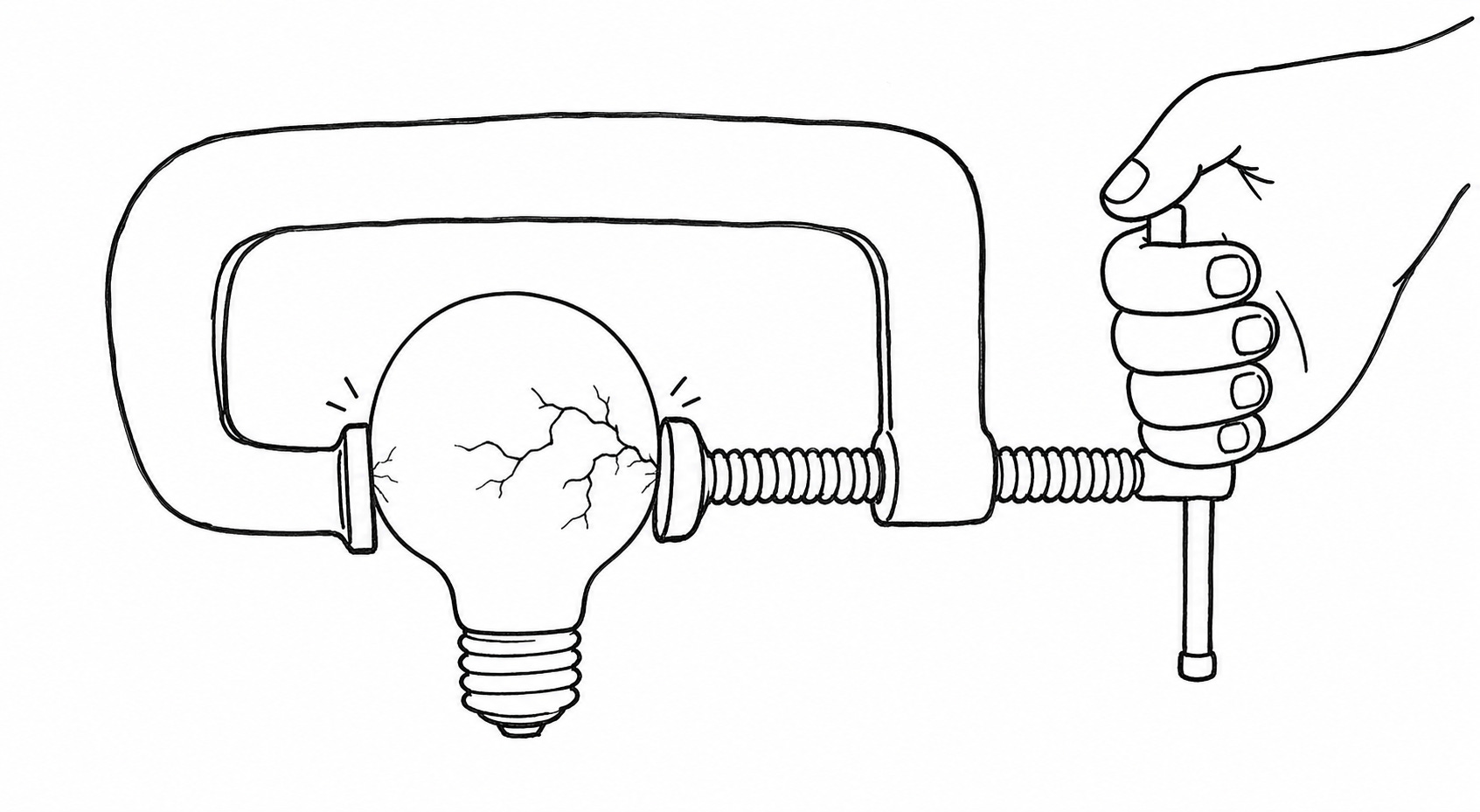
Which gives you one cheap unglamorous fix. Widen the measurement window. Stop asking only whether the assigned ticket landed by Thursday and start asking what valuable output this person created over the quarter.
Predictability is easy to observe and value takes longer to show up, and organisations trade the second for the appearance of the first roughly every day of the week.
This is not a permission slip
At which point somebody reasonably says: so people with ADHD should do whatever they feel like, ignore deadlines, and let everyone else absorb the consequences?
No. Freedom without design isn’t an operating model, it’s chaos with better vocabulary.
The contract changes on both sides, and I had to learn the second half the hard way. Neither list below is a wish. The first one is roughly what we actually run.
What the organisation provides:
several genuinely valuable problems to choose between
flexibility in sequencing
fewer pointless context switches
long uninterrupted blocks
roles where the outcome matters more than the procedure
help or delegation for the tasks that cause disproportionate paralysis
a longer measurement horizon
What I provide:
honest communication about uncertainty, up front, not after the miss
responsibility for the value of what I choose, not just the pleasure of choosing
visibility into what’s moving and what’s stalled
safeguards so no critical deadline depends only on me
actual delegation of the admin debt I know I can’t pay
a deliberately curated set of options rather than novelty-chasing in a systems-thinking costume
That last item on my side is the one people miss. Executive dysfunction is not a licence to only ever do the fun part. Somebody still has to book the doctor’s appointment, and in my case that somebody is a paid professional who tells me about it over messenger. The reason that’s legitimate rather than pathetic is that I stopped pretending I’d fix it and paid for a solution instead.
The same logic runs through everything that works for me. Sitting next to another person while I do the thing I can’t face alone, which has a name, body doubling, and which the community built long before the research turned up. Nothing about the messages changes. The terror does. Doing the horrible administrative things first thing in the morning, before the brain fills up with noise and shame and forty-seven unfinished mental tabs.
None of it is sophisticated. It’s just that nobody tells you it’s allowed.
So this isn’t the elimination of responsibility, it’s a transfer of it. You stop pretending that trying harder is a productivity system, and you take on responsibility for designing an environment where the brain you actually have does useful work.
Non-linear people for non-linear problems
Some jobs are predictable execution, and that is the product. If you’re in the critical path for a synchronised daily delivery and you can’t reliably show up, you’re in the wrong job. That’s a routing error, not a moral failure. Get out of the path.
But most of the work that matters has no guaranteed path and no honest deadline anyway. Research. Invention. Strategy. Writing. Early product. Complicated negotiation. Crisis. Finding the hidden constraint. The non-obvious solution. Anything with a high chance of failure and an enormous upside.
Those are Extremistan problems already, and they’re the natural habitat of a wide-range mind. “You can’t promise when” stops being a defect there, because nobody could promise when.
Which is a large part of why so many of us start companies. A founder always has the full spectrum available: product, hiring, technology, story, fundraising, research, crisis, culture, sales, strategy. There’s nearly always something genuinely important your brain is ready to attack today. Entrepreneurship is brutal in a dozen other ways and hands you exactly one luxury, which happens to be the one you need. Enough meaningful variety to keep the fan wide.
My colleagues know I won’t hit every individual date. They also know what the system produces when it’s set up properly. When I first said out loud that I wouldn’t be promising every deadline, people looked at me like I’d lost my mind.
Then they saw the other half of the deal.
The guilt tax
One more piece of structure, and it’s the expensive one.
I can’t start the thing, so I feel guilty. And the guilt isn’t free, it runs on the same budget as the work. Deliberate, effortful, self-directed processing, which is precisely what the task needed. So I have less. So I do less. So I feel worse. It’s the same reinforcing loop as the control spiral, running inside one skull instead of an org chart.
Guilt isn’t a motivator. It’s an expense, billed to the same account as the work.
Which is the only reason I get to say the next thing without it being a wellness platitude. Sometimes the network needs to run in passive mode. Go to the park, look at birds, do nothing on purpose, and don’t turn the rest into either a moral failure or another optimisation project. Guilt-flavoured rest is the worst of both: you pay the tax and get no services. Rest at full strength and it gives something back.
You have fewer options than they do
Most people can work almost anywhere. Take a job, tolerate it, treat life as the part that starts at six. That works for them, because the range is narrow and every job costs roughly the same to endure.
You don’t get that option. Not because you’re finer or deeper or more interesting, but because of the variance. The wrong job doesn’t cost you slightly more, it costs you an order of magnitude more, and it takes the evenings with it. Fit isn’t a preference for you, it’s structural.
Which is both a curse and a blessing, and which one it turns out to be is on you. That isn’t a warm thought. It’s a demand, and I’d rather hand you a demand than a consolation.
Now, the objection you’ve been holding since about the third section.
Easy for her. She owns the company. Of course she can announce she doesn’t guarantee deadlines, she’s the one they’re guaranteed to.
Yes. I know how much of this rests on the position I’m in, and I won’t pretend autonomy is a personality trait rather than a privilege. Though if you manage people, autonomy isn’t a perk you’re generously extending. It’s the operating condition for this particular resource. You provide it and get the output, or you don’t and you don’t. That’s a throughput question rather than an HR one, and it’s your job, not your employee’s.
But also.
I’m the daughter of a single mother, from a town small enough that it didn’t have a university in it. When I started studying we had no money. Not careful with money. None.
So I’ve been on the other side of this, with no leverage and no title and nobody’s permission, and what I did then was the same thing I’m describing now, just cruder and with worse tools. I leaned hard on the parts of me that worked absurdly well and I stopped negotiating with the parts that didn’t. I never fixed the email problem. I found work where the email problem was survivable and the other thing was worth a great deal.
Years later that still looks like the right call. Not a brave one, not an inspiring one. Correct.
And one more thing, since it took me two decades to work out.
Stop taking productivity advice from people who don’t have this. They’re not wrong, they’re right for themselves. Nearly everything ever written about focus and discipline and consistency was written by people in the narrow range for people in the narrow range, and inside that range it’s excellent. Two pages a day even if they’re terrible. Always commit to a deadline. Eat the frog. Hand that to a Mediocristan machine and it works.
Run it on yourself and you’ll conclude you’re a failure. On schedule. Roughly every three weeks, for years, which is what most of us actually do with our twenties.
Your system for managing yourself has to be different, because you are different. Not braver, not deeper, not more interesting. Different in a way somebody has already measured, the same way a Swedish research group measured one child twice in a single week and got two different answers, and the difference wasn’t in the child.
There’s nothing here to forgive and nothing to fix. There’s a system to design, and you’re the only one who can design it, because you’re the only one holding the data.
Press on the strengths. Ignore the weaknesses. Do it earlier than feels responsible.
Your hyperfocus is fine.
Go and look at what you’re feeding it.
If you want to go further
Two books and an essay carry most of the thinking here. Everything else is optional.
Donella Meadows, “Leverage Points: Places to Intervene in a System,” 1999 — and Thinking in Systems if it takes. Delays, feedback loops, and why interventions that feel decisive usually make things worse. Twelve pages, free, and it will permanently ruin your patience for most management advice. → donellameadows.org
Eliyahu Goldratt, The Goal, 1984. A novel about a struggling factory. Bottleneck, setup time, buffer, all of it comes from here. Somehow also the best book about attention I’ve ever read.
Nassim Taleb, The Black Swan, 2007, for Mediocristan and Extremistan. An argument rather than evidence, and I’m using it as vocabulary, which is what it’s for.
And if you want the specific claims checked:
The sport evidence, which is the best natural experiment we have. The same young athletes, scored twice in one week on a standard ADHD symptom scale, high for school and low for their sport: Ekman, Hiltunen & Gustafsson, “Do Athletes Have More of a Cognitive Profile with ADHD Criteria than Non-Athletes?”, Sports, 2021. Open access and short. → doi.org/10.3390/sports9050061 · free full text
Prevalence among elite and student athletes, roughly 7–8% against about 3–7% in the general population. Note that it’s a narrative review rather than a meta-analysis, so treat it as somewhat over-represented and not proof of anything dramatic: Han et al., British Journal of Sports Medicine, 2019 → doi.org/10.1136/bjsports-2019-100713
And the counterweight, because I’d rather you heard it from me: Hoare et al., “Neurodiversity in elite sport: a systematic scoping review,” BMJ Open Sport & Exercise Medicine, 2023. Twenty-three studies, most about concussion risk and anti-doping compliance. Sport hasn’t solved neurodiversity, it merely happens to be shaped correctly, which is the actual point. → doi.org/10.1136/bmjsem-2023-001575
Effort as a price rather than a fuel tank: Kurzban, Duckworth, Kable & Myers, Behavioral and Brain Sciences, 2013 → free version
Why a deadline a month out has almost no present value in this brain: Jackson & MacKillop, meta-analysis on delay discounting in ADHD, 2016 → doi.org/10.1016/j.bpsc.2016.01.007
Why more things in the queue means each one waits longer, which is Little’s Law in a book about product development rather than factories: Reinertsen, The Principles of Product Development Flow, 2009 → chapter 1, free
And in fairness, “hyperfocus” is a much shakier scientific construct than I’ve made it sound. The review that says so is open access: Ashinoff & Abu-Akel, Psychological Research, 2021 → PMC7851038. I’m using the word anyway, because everyone who has it recognises the description. Now you know what you’re getting.