

Somebody said it to me again last week. Different room, same sentence: “AI-native startups are growing insanely fast, that’s the new playbook, you should really think about it.” I get it from investors, from other founders, from people who read one Substack on Tuesday and have a whole worldview by Thursday.
Here’s the thing about me, though: I’m not the nod-along type. I say the quiet part out loud, right there at the table. Which ones, exactly? Name them. And the part that gets me every single time is how fast the answers dissolve the second you press on them. One company’s “growth” turns out to be the money it raised and nothing else. Another has gorgeous top-line numbers and loses money on every unit it sells. A third had a crowd show up, poke around for a month, get bored, and wander off — a toy, not a habit. I’m not doing this to win the room. I actually want one of them to hold up, because I’m building in this world too. They mostly don’t. So no, this isn’t me nodding politely while thinking my private thoughts. This is me having asked the question maybe a hundred times by now and slowly noticing that the emperor’s runway is showing.
Let me get one thing out of the way before I sound like a hater. As a user, I am obsessed with this technology. Every founder secretly wants to clone themselves five times just to keep up with their own ideas, and AI is the closest I’ve gotten to actually doing it. Pair it with my ADHD and it’s a straight-up superpower — I’m writing algorithms, sketching product, iterating at a speed that was flat-out impossible a couple of years ago. This is not skepticism. This is infatuation.
But being infatuated and being right are two different jobs, and the second one is mine. People love the phrase “think with a cold head,” as if clear strategic judgment requires you to be some dead-eyed operator running numbers in a dark room. It’s a dumb myth, and — let’s be honest — a very male one. I run a health company built on empathy. Empathy is the product. And I can still see straight through a bubble. Warmth and sharp logic are not opposites, they never were. The job was never to be cold. The job is to not let a room full of excited people (me included) talk me out of arithmetic.
So. The arithmetic.
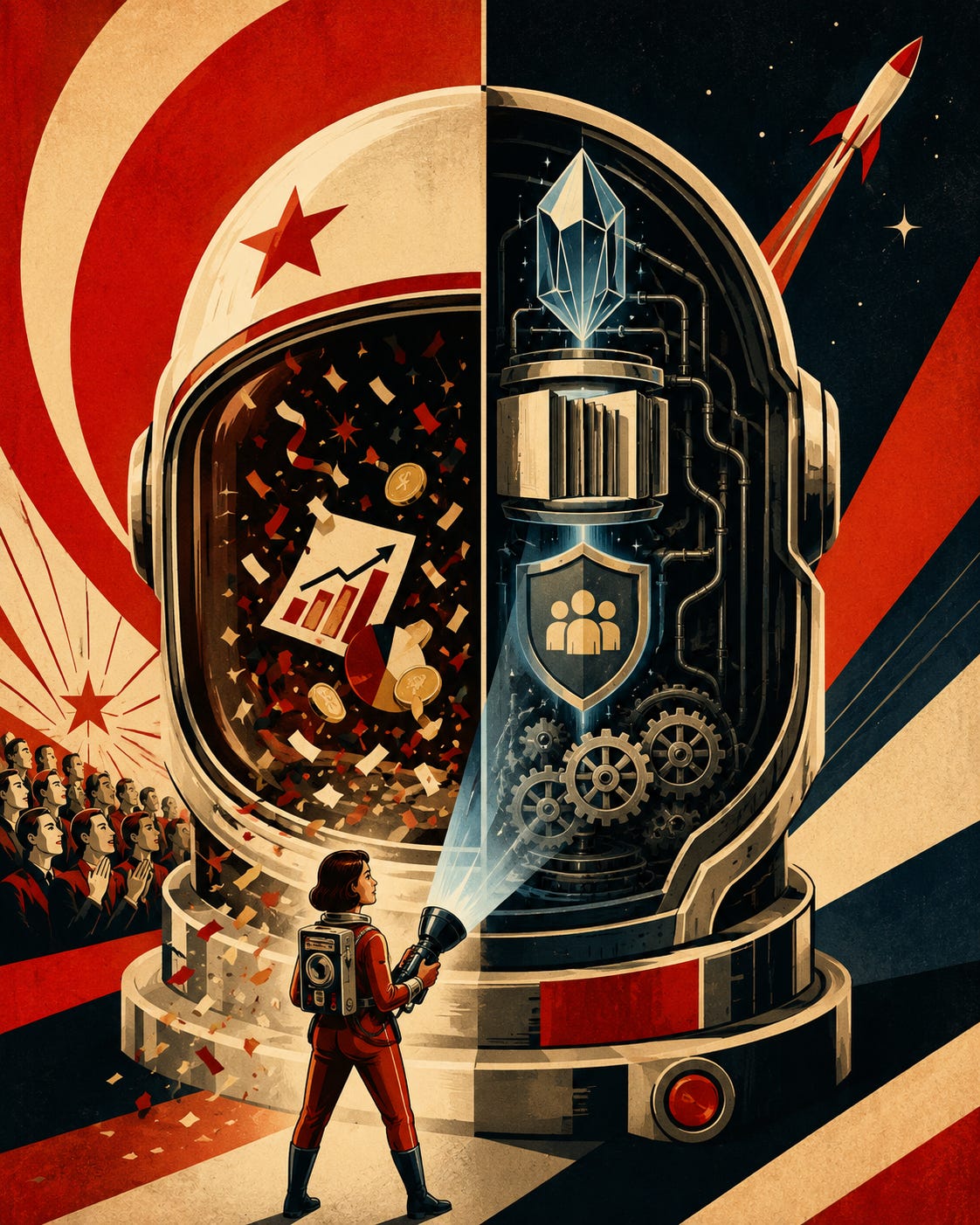
The two poster children
Start with ChatGPT, because it’s the one everyone points at first. The leaked, FT-verified 2025 numbers: about $13.07 billion in revenue, up from $3.7 billion. One of the fastest revenue ramps in the history of anything. And an operating loss of roughly $20.92 billion. (You’ll see a scarier $38.5 billion “net loss” floating around — ignore most of it. Around $41.5 billion of that is a one-time non-cash charge from the nonprofit-to-for-profit conversion, and I’m not here to inflate the drama; the real operating hole is plenty.) Bottom line, it cost them about $1.60 to make $1. So what did ChatGPT actually prove? That if you sell intelligence below cost, at planetary scale, people will happily consume an obscene amount of it. That’s a proof of demand. It is not a proof of a business. Usage is not a business model, and anyone who ran a startup in 2015 and tried to pay rent with “we have users” already knows how that sentence ends.
Then there’s Cursor, which is the one that actually keeps me up at night (that, and the monkeys on the roof, but that’s a different post). Cursor — Anysphere — became, by most measures, the fastest-scaling B2B software company that has ever existed: roughly $100 million to about $4 billion in annualized revenue in something like eighteen months. Faster than Slack. Faster than Zoom. Faster than Snowflake. The AI-native dream, in the flesh.
Now here’s what that dream actually bought them. For most of that run they were operating on negative gross margins. They were paying Anthropic retail API prices for the exact model their product ran on — while Anthropic was out there running its own competing product, Claude Code, at cost. Sit with that for a second. You are a reseller paying full sticker price for the one input your biggest competitor gets at wholesale. No amount of top-line growth fixes that. It just makes the leak wider and faster.
So how did the fastest-growing B2B company in history end its own independence? In June 2026 it sold to SpaceX for $60 billion. And — this is the part that matters — not for cash. All stock. Paper in an unprofitable company (SpaceX’s AI arm reportedly lost around $6 billion in 2025), locked up, with the founders unlikely to touch real liquidity before late 2027, at a number that floats around with the share price.
Credit where it’s due, because I’m not a ghoul about this: the founders and early investors might still make an absolute fortune. SpaceX stock could rip, the lock-ups could vest into serious money, and good for them if they do. But I’m going to keep pulling on the distinction everyone wants to blur, because it’s the whole game: a spectacular venture adventure is not the same thing as a durable business. Cursor is a phenomenal trade. It is not proof of a defensible company. It grew faster than anyone in history and still couldn’t stand on its own two feet or turn that success into cash on its own terms — it had to fold into someone bigger who owned the compute. If that’s the flagship of “AI-native wins,” what it really shows is that being the best in the world at building on top of someone else’s model is a great way to get bought and a lousy way to stay free.
And look — if the absolute flagship of dev tools, where users are practically begging to pay, couldn’t stand on its own, what does that say for the rest of us? Take my own corner: health and wellness. It is currently drowning in decks for “AI-native health coaches,” “autonomous diagnostics,” “generative wellness assistants.” So I’ll say the quiet part one more time: I do not know of a single one of those — the chat-first, coach-in-a-box, generative-assistant kind — that has built a real, sustainable, scaled business. Not one. (And before anyone @s me: the companies actually winning in health don’t call themselves “AI-native” anything. They run AI underneath a real care business. Hold that thought, we’ll get there.) The AI-native ones have beautiful Figma files, temporary user spikes, and the balance sheet of a ghost ship.
“But surely the one real thing it does is layoffs”
Fine. The celebrated startups don’t have durable economics. So the fair question comes back at me: then where has AI made real commercial money? What are companies actually, repeatedly paying for?
For a while my honest answer was one word: layoffs. That looked like the one thing AI had truly proven — not a shiny new capability, but permission to cut headcount. And the numbers dress the part. Challenger, Gray & Christmas tracks the reasons companies give for job cuts, and AI went from about 5% of layoffs in 2025 to climbing all through 2026 until, by spring, it was the single most-cited reason for layoffs in America. Salesforce quietly took its support team from 9,000 to 5,000 and said, more or less, that it needed fewer heads.
And then I actually dug into the data, and even that fell apart. Which, I’ll admit, delighted me.
Because look what happens when someone checks. Gartner surveyed 350 companies with over a billion in revenue — real deployers, not people kicking tires. Yes, 80% had cut staff, some by as much as a fifth. And there was zero correlation between the cuts and ROI. The ones who cut the most made about the same returns as the ones who cut the least, and in a bunch of cases the ones who cut less did better. Gartner’s own analyst said it flat out: workforce reductions can create budget room, but they don’t create return. Cutting people is simply not where the value lives.
And honestly, a lot of the “AI did it” is just theater. Nearly six in ten companies admit they’ve dressed up plain financial layoffs as “AI-driven.” Deutsche Bank has a name for it — “AI redundancy whitewashing” — and called it a defining feature of 2026. Even Sam Altman has copped to the “AI washing.” Challenger’s own chief revenue officer said it best: whether or not a role got replaced by AI, the budget for that role got taken by AI. So “AI” is doing double duty — part cost-cutting tool, part press release, and if I’m being real, mostly the second one. It makes a layoff sound like a bold strategy instead of what it usually is: you over-hired in the pandemic and you’d like to look modern about fixing it.
And where a company genuinely bet the business on replacing humans, it tends to blow up in slow motion. Klarna bragged that an AI agent was doing the work of 700 support people, watched service quality slide, and started hiring humans back. IBM automated big chunks of HR and quietly reversed when the system choked on anything requiring judgment. Commonwealth Bank in Australia cut 45 service roles for a voice bot, drowned in call volume, and publicly called it a mistake and apologized. Gartner expects half the companies that blamed AI for cuts to rehire — under fresh job titles — by 2027.
All of which rhymes with the MIT study everyone forwarded around last year: 95% of enterprise GenAI deployments showing no measurable return. So the one thing AI supposedly “proved” it could do turns out to be the thing it’s worst at proving. What Gartner did find is that the companies pulling real returns use AI as what they call “people amplification” — making their humans more powerful instead of deleting them. Hold onto that phrase too. It comes back at the end.
AI isn’t a moat. It’s a moat destroyer.
Here’s the engine under all of this, and it’s exactly backwards from what the “go AI-native” crowd believes. Every technology wave kills something. What this one kills is the cost of producing things — software, content, analysis, generic expertise. And the very first things it fully commoditized were text and code, which happen to be the raw material most SaaS and most small apps are made of.
Think about what that does. If the marginal cost of making the thing your product makes is racing to zero, and a foundation model will spit it out on demand for anybody who asks, then the thin SaaS layer and the one-trick app have no floor left to stand on. They’ll die. Not because they’re bad — because their value became free. What survives is never “the app.” It’s whatever is hard to get behind it: proprietary data you had to generate one interaction at a time, network density, regulatory clearance, trust, the accumulated history of a specific human being. And the thing all of those share is that they took real, elapsed time — time you cannot parallelize. A competitor with infinite compute still can’t buy ten years of my users’ history. That’s the whole game, right there. So when a founder tells me “our AI is the moat,” I mostly just hear quiet, because if your magic is rented from a model provider who can ship the same feature next Tuesday (hi, Cursor), the magic was never yours to begin with.
Technology hands you the timing. It never hands you the vision.
Now the optimists will say: but Jane, this is a platform shift, like the internet, like mobile, like cloud. And they’re right about that. It’s the lesson they draw from it that’s wrong.
Go back and actually look at who won the internet. Not one of those companies had a vision about the internet. Google’s insight wasn’t “let’s build a web thing,” it was getting you to intent — solving the very human problem of finding an answer you didn’t know how to phrase. The web just made indexing cheap enough to do it at scale. Amazon’s vision wasn’t “an online store,” it was infinite selection and obsessive logistics and stripping every ounce of friction out of buying. The browser was just the timing that made the catalog free to deliver. Netflix’s whole thing was “watch what you want, when you want” — broadband merely decided the exact year that flipped from mailing DVDs to streaming. Uber didn’t invent on-demand rides; the GPS phone in your pocket just made matching supply and demand possible in ten seconds instead of never.
Every single time, the platform shift didn’t supply the value. It lowered the delivery cost of a desire humans already had. Build your strategy around “we use the new platform” and you’ve mistaken the pipeline for the water.
Which is precisely why “let’s do something with AI” is not a strategy. It’s bullshit without a moat — and I mean that technically, not as an insult. Everyone has the same models. So “we use AI” isn’t a differentiator, it’s the shared starting line of the entire race. It’s a 1999 pitch whose big idea is “we use the internet.” Cool. So does the pizza place. (And “vertical AI,” the fancier version — pick a narrow market, sprinkle AI — is the same mistake in a nicer blazer. Vertical is a choice of where, not what or why. It’s an address, not a house. Even Bessemer, who evangelize vertical AI for a living, admit in their own writing that the models will stop being a moat and defensibility has to come from data, integration, and delivered economic value.)
So here’s the deflating truth for anyone hoping AI rewrote the rulebook: it didn’t touch the hard part. The hardest thing about building a company was always finding the combination — the right timing, a genuinely new offering, a business model that makes money and keeps making it, and a way to grow that doesn’t eat itself alive. AI widened the space of what’s buildable and pulled the timing forward. It did not, and will not, hand you the vision, the economics, or the moat. Believing it will is the entire AI-native illusion in one sentence.
“But all the smart money is piling in”
I hear this one every time, usually as the closing move. “Come on, all the smart money is pouring into AI-native. That has to mean something.”
For a long time I answered this the polite way: they’re not idiots, they’re just playing a different game than you are. And that’s true — for a few of them. But I went and pulled the actual fund-level numbers while writing this piece, and honestly, they moved me off the polite version. So let me split “smart money” into the two very different things it actually is.
Start with the power law, because it explains why the real players are rational. Correlation Ventures went through more than 20,000 financings and found roughly 65% of them return less than the money put in; Horsley Bridge’s numbers put about 6% of deals behind 60% of all the returns. A VC doesn’t need most of their bets to work — they need exposure to the one that goes vertical. That single fact makes a genuine top-tier firm rationally, cheerfully willing to pay prices that look deranged to someone like me, who holds exactly one bet: my company. And the best of them have real edge — access to the founders everyone wants, judgment earned over cycles, a brand that pulls the next round in on its own. If one of those backs you, it means something. Give them their due.
The problem is how few of them there are. Zoom out from the winning deals to whole funds, net of fees, and the story inverts. When the Kauffman Foundation — a large, sophisticated LP — audited its own twenty years across nearly 100 “top-tier” funds, 62 of them failed to beat a public-market index after fees and carry. Only 20 beat it by the 3% a year that’s supposed to be the entire reason you lock your money up for a decade. Not one fund over $500M returned even 2x. Kauffman’s own gut-punch conclusion: there weren’t enough genuinely good funds to absorb even their modest capital. Even the industry’s flagship index only barely edges the S&P 500 over ten years and quietly loses to it over twenty-five — and that index is capital-weighted, propped up by a handful of giants, so the typical fund does worse than the “average” everyone quotes.
And this isn’t ancient history. Carta’s 2025 data on roughly 2,800 recent funds says the same thing in a fresh accent: by early 2025, fewer than 40% of 2019-vintage funds had returned a single dollar of real cash to their LPs. The median fund looks respectable on paper — a TVPI near 1.8x — but paper isn’t money, and even the top decile of recent vintages has paid back under fifty cents on the dollar in actual distributions. Put Kauffman, Carta, and the academic PME work in one pile and the odds that a random LP in a random fund beats what an index fund would’ve handed them, in real net cash, land somewhere around one in four or five.
So what is the other three-quarters of the money actually doing? Running an assets-under-management business. The 2-and-20 structure pays a GP roughly 2% a year on the pile they’re sitting on whether it performs or not, plus paper markups every time a portfolio company raises at a higher price. As long as the music plays, the markups look like genius and the fees clear either way — the GP’s personal income is basically guaranteed by gathering assets, not by returning them (they typically put in about 1% of their own money). And whose money is the rest? Not the GP’s. It’s the LPs’ — a lot of it pension money, which is to say teachers and firefighters and people planning to retire on it. The person making the fast, thrilling AI-native decision and the person holding the slow, quiet risk are not the same person. They’re not even in the same building.
On top of that sits career risk, the real engine underneath. For a VC, missing the platform shift is the thing that ends funds and careers. Losing money alongside everyone else, in the same hot names, at the same time? Forgivable. Survivable. So the professionally safe move is to be in the trade even if you privately think it’s overcooked. Carlota Perez described this pattern decades ago — new platforms get an installation phase of overbuilding and bubble before the useful deployment phase shows up. Even Sequoia said the quiet part out loud with its “$600 billion question”: the gap between what’s being spent building AI infrastructure and the revenue that would have to exist someday to justify it.
I’m not going to tell you when the music stops. I don’t know, and anyone who says they do is selling something. But I know how the incentives are arranged, and I know who’s left holding the risk when the chairs disappear — and it isn’t the GP, and it definitely isn’t the retired teacher. So here’s all I’m actually claiming: a check is information about an investor’s incentives — mostly fees and career risk — and for most of the crowd it isn’t even a verdict that would beat an index fund. It is not information about whether you should bet your one life on being “AI-native.” A check is not a prophecy.
So I went and asked the machines what they believe
Here’s the bit that started as a joke and stopped being funny. Instead of only reading the hype, I sat down and interrogated the AI models themselves — asked them to lay out, decade by decade, what “everyone knew” about AI at each moment and how each conviction aged. (That’s the timeline I’ve attached at the bottom, if you want the receipts.) And the same shape repeats every single time: a confident belief, a flattering metric, a hidden trap, and then reality quietly walking up with the bill. “Better algorithms will beat the incumbents.” “The model layer captures the value.” “Every vertical gets a copilot.” “Agents will replace your labor budget.” Each one obvious in hindsight. Each one gospel at the time.
But the list wasn’t the interesting part. The interesting part was what happened when I pushed one of the models on why it produces this stuff so fluently. To its credit, it didn’t get defensive — it just explained its own bias, mechanically, no mysticism. It’s built from the same pile of text the rest of us drink from, and that pile is lopsided: hype gets written early, loud, and in enormous volume, while the post-mortems come late, quiet, and rare. Winners publish “how we did it.” The dead just go silent. So the machine is trained on far more promise than reckoning, and its default voice leans toward the sell.
And then it said the thing I keep chewing on: it has no skin in the game. No scars, no memory of getting burned, nothing on the line if it’s wrong. So its confidence is uncalibrated by design — it’ll back a well-argued hype thesis exactly as happily as a well-argued skeptical one, riding whichever way the corpus tilted most recently. Which means if you’re using AI to help you decide whether to go “AI-native,” you are consulting an oracle assembled out of the precise enthusiasm you were trying to see past. It isn’t lying to you. It’s reflecting you.
And that’s the actual punchline, and it’s not about the machines at all. The skew in the models is our skew. All of us — the press, the founder feeds, the pitch decks — over-celebrate the promise and under-examine the failure, and the model just concentrates that imbalance and hands it back at scale, with better grammar. The tool didn’t invent the hype. It’s a very fluent mirror. Which is exactly why the correction can’t come from the tool. It has to come from the person holding it — the one with actual skin in the game — asking the right question.
What this looks like from my chair
And the right question is never which hammer. When someone asks me “are you going to be AI-native?” it lands like a client asking which brand of hammer I’ll swing instead of asking what house I’m building. It’s confusing the tool for the goal. And when the only thing a person can tell you about their project is the hammer, it usually means there’s no blueprint.
(Fair caveat, because I like arguing with myself: AI is a livelier tool than a hammer. It’s more like electricity showing up on the site — it genuinely changes which houses are worth building and how big. But that just sharpens the point. The question is never “which hammer,” and it isn’t even “now that there’s electricity, are you electricity-native?” It’s: what can I build now that I couldn’t before, and why am I the one who gets to build it and keep it?)
Which brings me home, to my own turf, where I watch the wrong question get asked in the dumbest possible way. In health, the lazy AI-native answer is “build an AI health coach.” It demos beautifully, it’s catnip to investors, and it is operationally useless. Chat is reactive by nature — a person opens it once they already have a symptom, a question, a small hot panic. But preventive health, the entire point of what we do, has to work before you know what to ask. A coach that waits for the question is already too late. Asking the right question, at the right moment, with the right physiological context — that’s the hardest part of medicine. Leave a scared person staring at a blinking cursor and you haven’t helped them, you’ve handed them the clinical judgment and walked away.
I’ll confess we almost drank the Kool-Aid ourselves. Last year, under real pressure from the market narrative, we caved. We spent months and built the damn AI chat. Wired it into our decade of health data, designed the UI, got it ready to ship. And then we sat in a room, looked at the thing, and decided not to launch it — because it was chat theater. It wasn’t improving outcomes. It was just me offloading the burden of clinical judgment onto an anxious person and calling it a product.
And then the universe handed me the punchline. Right after we killed ours, OpenAI and half the industry shipped exactly the thing we’d just buried — the generalized health assistant, ChatGPT Health and its cousins. For about a day I had the classic founder night-sweat: did we just leave the future on the table? Then the usage numbers landed, and they were enormous. Something like 230 million people a week now ask ChatGPT about their health, more than 40 million a day; health is one of the single most common things people do with it. And here’s what took me a beat to see clearly: that didn’t prove me wrong. It scaled the exact thing I refused to ship. Two hundred and thirty million people a week alone with a blinking cursor and their own fear is not care. It’s the reactive problem, at planetary scale. Usage was never the scoreboard I was scared of — I told you up top that usage isn’t a business, and it isn’t a treatment plan either.
And it’s not just hollow, it’s unsafe. In February 2026 a Mount Sinai team ran the first independent safety evaluation of ChatGPT Health and published it in Nature Medicine — 960 responses across clinical scenarios. It under-triaged 52% of the gold-standard emergencies: diabetic ketoacidosis, impending respiratory failure, waved off with “see someone in a day or two” instead of “go to the ER now.” (There’s an honest methodological fight about this — a Macquarie group argues the exam-style format inflates the failure rate. Fine. But notice the counterargument is “you can’t evaluate a health AI like a generic assistant,” which is exactly my point. You also can’t deploy one like a generic assistant.) Now picture that failure rate as your entire company, in a chat box, at planetary scale, with “move fast” stitched on the wall. It’s a matter of time before someone gets hurt.
The companies actually winning in health aren’t doing chat theater at all — they’re fixing the economics of care. Look at Hinge Health: about $588 million in revenue last year, up 51%, 83% non-GAAP gross margins, $180 million of free cash flow. AI runs underneath as the nervous system of the product — automating how care gets delivered, bending the economics — instead of cosplaying as a character in a chat window. That’s the Gartner phrase from earlier, “people amplification,” made concrete: AI making something real more powerful, instead of being the pitch.
So the question a founder should be asking isn’t “should we become AI-native?” It’s: what do we know, own, collect, validate, or deliver that AI can amplify? What’s the vision — the thing AI is finally giving us the timing for — as opposed to “let’s bolt a model onto it”? If the honest answer is “nothing,” then going AI-native just makes you faster to copy, and you’ll die alongside the thin SaaS from a few sections back. But if the answer is real — proprietary data, closed knowledge, earned trust, a workflow people live inside, ten years of accumulated context — then AI is the most powerful amplifier anyone has ever handed you.
Here’s the test I’d leave you with, and then I’m going back to staring at the sea. Take your strategy and delete the word “AI” from it. If what’s left still describes a company with a reason to exist and something nobody can cheaply take from you — you’re fine. Go build. Use every model you can get your hands on. But if deleting that one word makes the whole thing collapse, then I’m sorry: you didn’t have a strategy. You had a costume. And this is a very bad season to get caught wearing one.
If you’re wondering what I’d actually bet on once that word is gone — my current list is short. Unique data that’s genuinely hard to collect. Unique knowledge, algorithms, ontologies that are hard to copy. And relationships — empathy, trust, the whole web of ties between people — that you simply can’t automate. Almost everything I’ve watched survive sits in one of those three buckets.
Though — full disclosure — those are just my bets, today, from this chair on this island. A year from now I fully expect to be smarter than I am right now (I usually turn out to be, which is a generous way of saying I’m reliably wrong about something). And that’s the actual ending, the least inspirational one I’ve got: nobody hands you the answer. Not me, not a VC, not a model built out of all of us. Each of us makes the call alone. So make yours.
Appendix: The AI Business-Model Evolution — a timeline of what “everyone knew” in each era, the flattering metric, the hidden trap, and what reality proved. Attached separately.
