

Okay. This is the nervous part.
I always assumed I’d write a book one day. I also assumed it would be about startups, technology, building things, why people do what they do — the stuff I write about here. Instead, through a strange chain of events, my first book isn’t about the thing closest to me. It’s about the thing closest to the people who use our app. Apparently it’s easier to answer somebody else’s need than to sit down and do what you personally feel like doing. I’ve decided that isn’t the worst thing to learn about yourself. So here it is. I’ve published a book, free to read and download.
It’s the result of about a year of digging into a condition called post-exertional malaise — PEM.
PEM is under-recognised, hard to diagnose, and a lot less rare than the medical system has caught up with. And — this is my impression from looking at data, not a published statistic — the people it happens to keep being younger than I expect them to be.
I ran into it because it broke our algorithms. The numbers stopped behaving the way the model expected them to: activity that should have produced a good day produced a bad one, two days later. I remember the exact feeling — *what on earth is going on here* — and going off to find out. That was a year ago, when I first understood how serious this is.
I’m not a guru, and there’s no unique method in this book. I’m a nerd who spent a very long time staring at people’s data and an even longer time in the scientific literature, trying to understand what I was looking at. So what I wrote is a set of notes. I tried to put them in plain words, so that anyone else who wants to understand this thing has an easier time of it than I did.
It is a review of published research, not a report of research of my own. It isn’t medical advice. It’s written in my own capacity, not as anything from Welltory, and I’ve been careful to say so inside the book too. And I obviously didn’t do this alone. My friends and people who were interested in such a book read drafts and told me when a paragraph was wrong, or unclear, or said more than the evidence actually supports. Someone with real scientific training went through the claims and made me take numbers out — which is not a pleasant experience and is exactly what I needed. People living with this described what it is actually like, in detail, more than once, using energy they did not have much of to spend on explaining anything to anyone. And a great deal of what’s in the book rests on work done by patient researchers who were describing this condition carefully years before the formal literature caught up with them.
Thank you. Genuinely. Whatever is still wrong in there is mine.
So. First book. Very nervous. And I really hope it helps someone.
It’s open-source, completely free, available on GitHub.
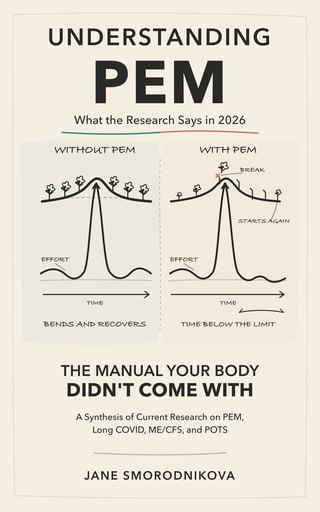
GitHub: Understanding PEM: What the Research Says in 2026
— read online, or download the PDF or EPUB. Free, CC BY-NC-ND.