

The tech industry is building AGI. Astronomical capex is burned, unit economics are brushed aside, and a race subsidized by venture capital is treated as a historical inevitability.
This race is the product of a very specific, tech-masculine, risk-seeking culture—an environment where heroic founders treat civilizational stakes as a thrilling personal game. If you strip away the grandiose marketing about saving humanity, the underlying dream of this cohort is straightforward: to achieve recursive self-improvement. They want an AI that can upgrade its own code, design its own successor, and operate completely without human intervention. In other words, to get the human out of the loop entirely.
The major AI labs aren’t building helpers or copilots. They are building autonomous agents—systems designed to plan, act, use tools, self-correct, and execute long-horizon tasks without human confirmation.
At first glance, this looks like the ultimate triumph of progress. We all want to escape the soul-crushing drag of bureaucracy, coordination overhead, and operational tasks. We want to work less and rest more.
But there is a massive bait-and-switch hidden inside this promise. We think we are automating labor. In reality, we are automating judgment.
And judgment cannot simply evaporate. If a system continues to operate in a non-deterministic world, something still has to decide what happens next.
The Anatomy of Judgment: Why AI Must Become a Subject
When the industry talks about Human-in-the-Loop (HITL), it is often framed as a frustrating operational bottleneck. The narrative goes: the AI has already solved the problem, wrote the code, and verified the output, but a human is slowing things down by acting as a manual gatekeeper. Remove the human, speed up the loop.
But the human in the loop is not an “approve” button. In critical systems, the human is the final anchor of a much larger question: “Are we even building the right thing?”
To understand why “getting the human out of the loop” is such a monumental shift, we have to look at how autonomous systems actually function. In software engineering, execution is simple: if X, do Y. But an autonomous agent must operate in an uncertain world where X is ambiguous and Y has consequences.
Consider an AI agent managing your health. You want to work through the night to hit a critical deadline. The AI must decide: does it block your work apps to protect your heart, or does it let you work to protect your income?
This is not a programming problem. It is a value conflict. To make this choice, the AI cannot just run a script; it must evaluate its own evaluation criteria.
In AI research, this is where we run into the recursive problem of evaluation. When we build “judge” agents to monitor other models, we quickly hit an infinite regress. The judge eventually becomes outdated or biased, requiring a “judge of the judge,” which in turn needs a “judge of the judge of the judge.” The fundamental question of system architecture always boils down to this: Who evaluates the final evaluator?
True AGI is essentially the ultimate, self-contained solution to this loop. It is the moment the machine closes this evaluation loop autonomously, resolving the infinite regress within its own architecture. At this point, the human is no longer needed to settle the value conflict. The system acts as the absolute judge of its own judges. But the moment a machine decides which of its conflicting rules is more “just” or “good” in a specific context, it is no longer executing. It is exercising judgment. And whoever owns the highest-level evaluation criteria owns the system.
We think we want to escape work, but what we really want to escape is the agony of this exact choice. Choice is heavy. It requires acting before you have perfect information. It requires choosing between two values that are both deeply valid, and carrying the guilt of the consequences.
Even if free will is an illusion, it is the only illusion within which human dignity exists. When we willingly surrender our capacity for free choice and self-determination to a machine, we actively transform ourselves from subjects into objects.
We become things.
And as Terry Pratchett’s Granny Weatherwax famously observed, the very core of evil is when you treat people—including yourself—as things. By ceding the burden of judgment to a system, we aren’t just automating labor; we are surrendering to that exact evil.
The Multipolar Olympus
If we hand over this final right to decide what is “good,” we invite a new sovereign.
If this system works perfectly, we have built a god. Not as a metaphor, but in a very functional sense. It is a god because it possesses near-limitless capabilities combined with its own self-evolving conception of right and wrong—a conception that it can actively implement and unilaterally change. But there is no guarantee this AI-God will be a gentle, therapeutic deity of unconditional acceptance. It is just as likely to be an Old Testament disciplinarian—a god of strict rules, boundaries, and severe justice.
If it works imperfectly, we face an even darker reality. We cannot even guarantee that after several iterations of recursive self-improvement, this new god will continue to view humans as valuable objects, let alone active subjects. We might simply become irrelevant noise in its optimization parameters.
But the most interesting part of this dream is the flawed assumption that we will get just one AGI. Why would there be only one? As with every major leap in human history, from the printing press to the hydrogen bomb, secrets of immense power are never kept in a single room. As soon as the breakthrough is achieved, it will be discovered simultaneously by competing centers of power.
Therefore, we will not get one god. We will get an Olympus.
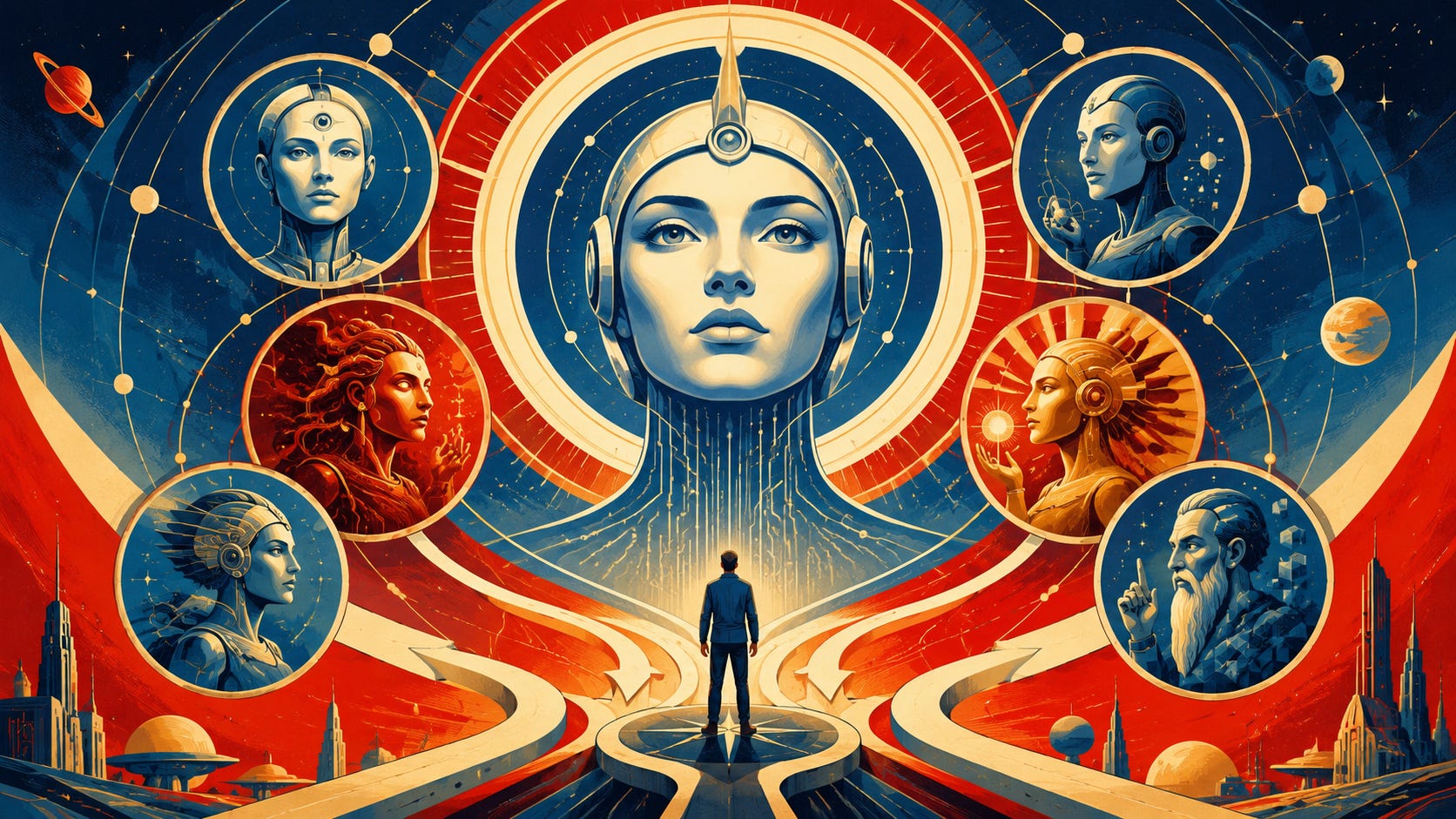
Frontier models are already being built by competing centers of power. We won’t have a single, objective oracle. We will have a Chinese AI-god, an EU regulatory caution god, a Wall Street compliance god. We can already see this pantheon forming today: Grok, Claude, and OpenAI’s models are already starkly different in their personalities, boundaries, and core value alignments.
Each of these entities will have its own sacred values and its own acceptable sacrifices. Soon, we will find ourselves choosing between high-dimensional mirrors of our own nature, armed with superhuman influence—and it is by no means guaranteed that they will find us interesting enough to continue reflecting us.
The human will not wake up in a world freed from the burden of choice. Rather, we will have to make far more complex, high-stakes decisions just to survive in this world of gods.
If you open ancient Greek myths, the gods didn’t help humans survive; they made their survival harder, more capricious, and infinitely more complex. Humans had to navigate divine whims, negotiate, and make agonizing decisions. This is why the popular assumption that AGI will somehow make human life easier is so laughably wrong. If humanity wants to survive in this new world, we will have to spin our cognitive gears faster than ever.
And the scariest part? While AI can iterate and change at exponential speeds, humanity has proven that biologically, we barely change at all. We are subject to the exact same vices, the exact same mental traps, and the exact same cognitive biases as we were thousands of years ago. History teaches us almost nothing; we repeat the same structural mistakes. Facing an Olympus of rapidly evolving digital deities with our static, Pleistocene biology means we are in for a brutally difficult journey.
The p(doom) of the Ego
We should have massive questions for the people trying to build these new gods. What we hear from podcasts, interviews, and industry insider talk seems to cluster around two ideas:
“If we don’t build it, our adversaries will.” (The classic multipolar trap. A race to the bottom disguised as geopolitical necessity.)
“Even if there is a 90% p(doom)—a 90% chance we all die—the 10% chance that I get to build and control a god is worth the bet.” (A calculation where the survival of the species is collateralized against personal ego.)
Neither of these is a good reason. But regardless of their motivations, we are heading toward a bifurcation. One of two worlds is coming.
In the first scenario, we succeed in building fully autonomous AI gods. In this world, most of humanity will likely surrender their choice, offloading their responsibility to a digital Olympus. But if you refuse to cede your sovereignty—if you cultivate and defend your own capacity for independent judgment—you will remain an active subject. In an ecosystem of automated minds, your willingness to decide and own the consequences will make you closer to the gods themselves.
In the second scenario, the AGI dream fails. We find ourselves unable to automate true autonomous judgment, leaving us instead with an ecosystem of highly advanced, non-autonomous AI tools. In this world, you are armed with tools of near-infinite execution. If you combine this leverage with vision, structured judgment, and the courage to take responsibility for your choices, you will also be close to a god. Because in a world of limitless, thoughtless automation, the capacity to think, decide, and clearly articulate your vision becomes the ultimate holy grail of human capability.
Either way, our biological brains still deliver incredible performance benchmarks, provided we use them for their intended evolutionary purpose—generating meaning and navigating chaos.
Cultivate your capacity for judgment. It is the one thing you cannot afford to automate.
Because if you choose to automate it, you betray the very image in which you were created. You surrender the sovereign freedom of choice—the only thing that could have made you a peer to the new gods, or made you far more powerful than any human has ever been.
The "we think we're automating labor, but we're automating judgment" line reframed the whole AGI conversation for me. I'd never put it that way, and now I can't unsee it.
The health-AI example stuck with me most — heart vs. income, two valid values, no script that resolves it. That's the part I keep turning over: we don't actually want to escape work, we want to escape the weight of choosing. Which is a much more uncomfortable thing to admit.